Author
Compose SwitchRules, decision tables, and Compute nodes in the browser. CEL expressions for predicates – sandboxed, fast, familiar to anyone who has touched Kubernetes.
A modern BRMS your risk team and developers both like. Author business rules visually. Version like code. Serve via APIs with single-digit-millisecond latency.
Book a demo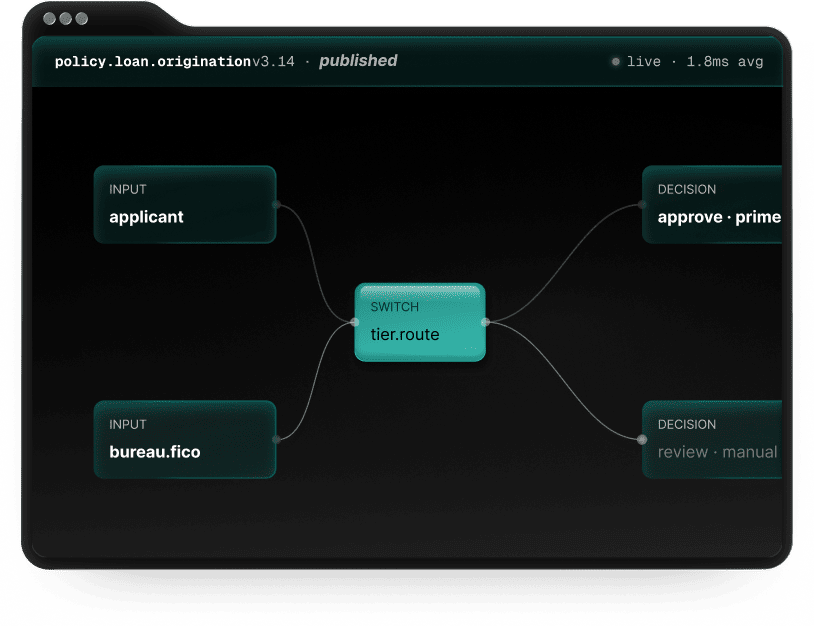
The Problem
A risk team writes a rule. Engineering writes a JIRA. Six weeks later, an appliance ships. By then the policy is wrong, the consultant is paid, and the deal is dead.
The policy doc says one thing. The Python service does another. The Excel sheet underwriters actually use does a third. No one knows which one decided.
“Why did you decline this customer on March 4th?” The honest answer involves a deploy log, a deleted branch, and a developer who left in May.
How It Works
Compose SwitchRules, decision tables, and Compute nodes in the browser. CEL expressions for predicates – sandboxed, fast, familiar to anyone who has touched Kubernetes.
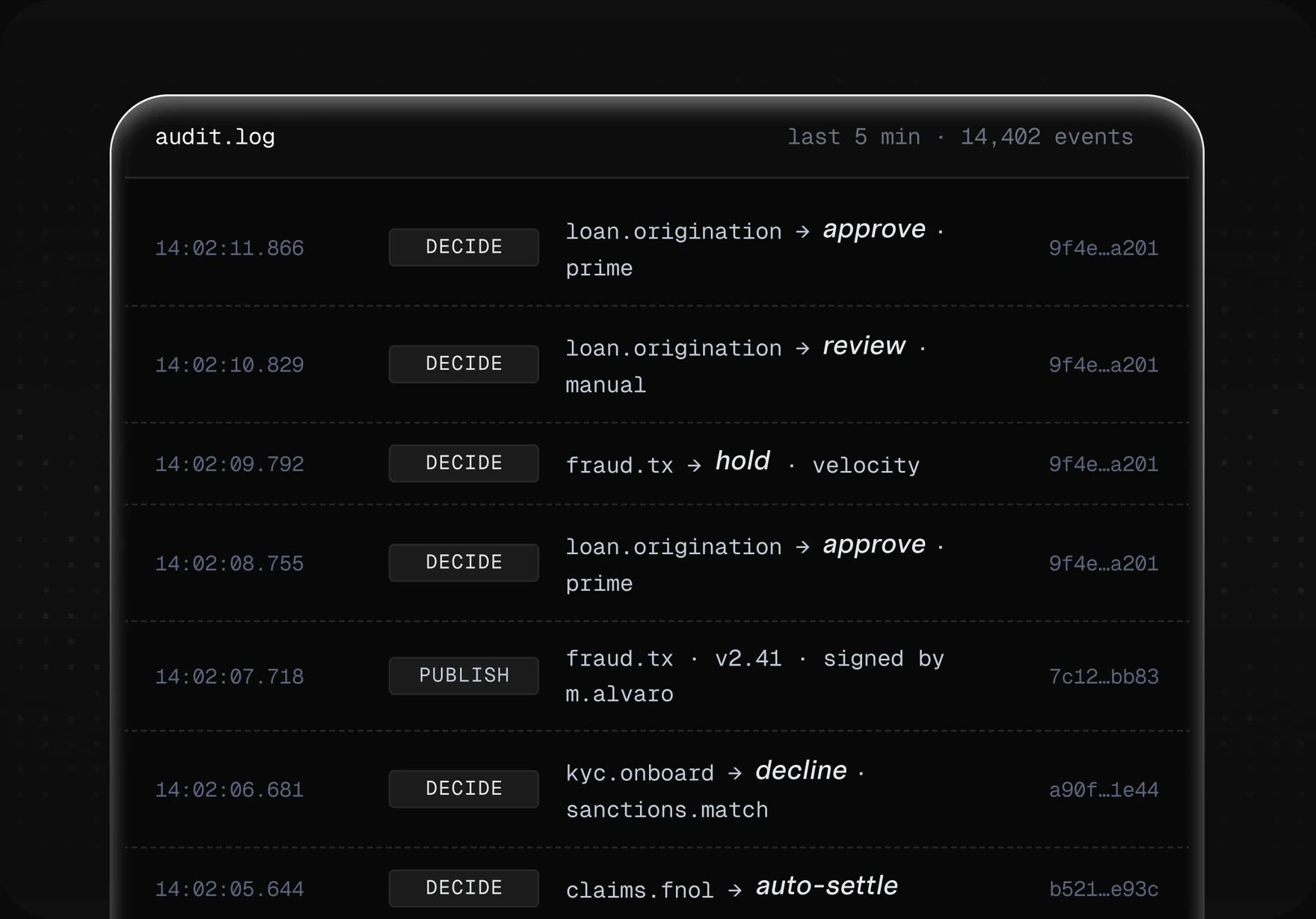
Cerebra compiles the graph to an in-memory program, hashes it with SHA-256, and writes the result to an append-only registry. A reviewer signs off. The pointer flips.
Your service POSTs JSON. Cerebra resolves the live registry, runs the program lock-free, returns a decision and the exact node path that produced it. Every call is recorded.
The Landscape
Built for Regulated Workloads
Lending, KYC, fraud, claims, eligibility. The decisions auditors care about most are the ones engineers have the least time to instrument.
Architecture You Can Trust

Single static binary. No JVM, no proprietary runtime, no agent.

Battle-tested, replicated, point-in-time recoverable. The boring choice, on purpose.

One POST /api/evaluate. JSON in, decision out. Drop in.

Multi-region by default. Dedicated single-tenant regions on Enterprise. No infra for you to run.

Map your existing groups to author / reviewer / publisher.

Programs are in-memory; evaluations are lock-free atomic reads.
Where It Ships
A SwitchRule is a SwitchRule whether it routes a loan or a claim. Pick an industry — see the graphs Cerebra is built to run.
From application through origination to portfolio review. Risk owns the policy, engineering owns the SDK, audit owns the trail. No one owns a spreadsheet.
Bureau pull → tier → instant approve / manual review.
APR bands by FICO, DTI, and tenure.
Device, velocity, and ID-document signals.
Sanctions, PEP, address-history thresholds.
Initial line and step-up schedule.
Queue assignment by complexity and SLA.
In the Wild

Pull bureau and income, tier the applicant, route to instant-approve or manual review. 47 rules. One graph. Underwriters edit it themselves.

Velocity, device, geo, merchant category, and a model score. Six branches, two outcomes — pass or hold for review. Every threshold is a version.

Geography, age, occupation, coverage limits. The graph reads like the underwriting manual — because the underwriting team wrote it.
Developer Experience
No SDK to vendor. No DSL to learn. No agent to install. POST a payload, read a decision. The reverse-loop is the same — push a graph, get back a version hash.
docker run cerebra/dev on your laptop.$ curl -X POST https://api.cerebra.io/v1/evaluate \ -H "Authorization: Bearer $CEREBRA_KEY" \ -H "Content-Type: application/json" \ -d '{ "graph": "policy.loan.origination", "input": { "applicant": { "income": 92000, "dob": "1989-04-12" }, "bureau": { "fico": 742, "delinq_24m": 0 } } }'{ "decision": "approve", "tier": "prime", "fired_node": "tier.route#3", "node_path": ["applicant", "tier.route", "approve"], "version": "3.14", "program_sha": "9f4ea201bc54…", "latency_ms": 3.4}Pricing
No per-seat tax on your risk team. No five-figure procurement to ship one rule. Pay for evaluations and graphs — the things that actually scale with your business.
For teams shipping their first decisions in production.
For production at scale, with the controls auditors ask for.
For regulated workloads, dedicated regions, and named support.
All plans · SOC 2 Type II · OpenTelemetry on every call · Region: us-east, eu-west, ap-south
FAQs
Cerebra is a modern business rules management system (BRMS). Author decision logic as a visual graph, version it like code with SHA-256 hashes, and serve it over an API with single-digit-millisecond latency.
No. Cerebra is an orchestration layer that sits alongside your services. Your application POSTs JSON to a single /evaluate endpoint and gets a decision back — no core replacement, no appliance to run.
You author in the browser, a second reviewer signs off (four-eyes review), and the live pointer flips atomically. The swap is lock-free and any prior version is one click away.
Yes. Every evaluation is written to an append-only log with the input, output, fired node, and exact program hash. Sign it and ship it to your warehouse or hand it to your regulator.
Programs are compiled to an in-memory representation and evaluated lock-free. Typical latency is ~1ms at P50 and under ~4ms at P99.
Usage-based, from $499/month. You pay for evaluations and graphs — not per-seat licenses or six-figure procurement. Enterprise plans add dedicated regions and named support.